Additive Manufacturing: What It Is and Why It Matters in 2025
December 23, 2025 2025-12-23 9:06Additive Manufacturing: What It Is and Why It Matters in 2025
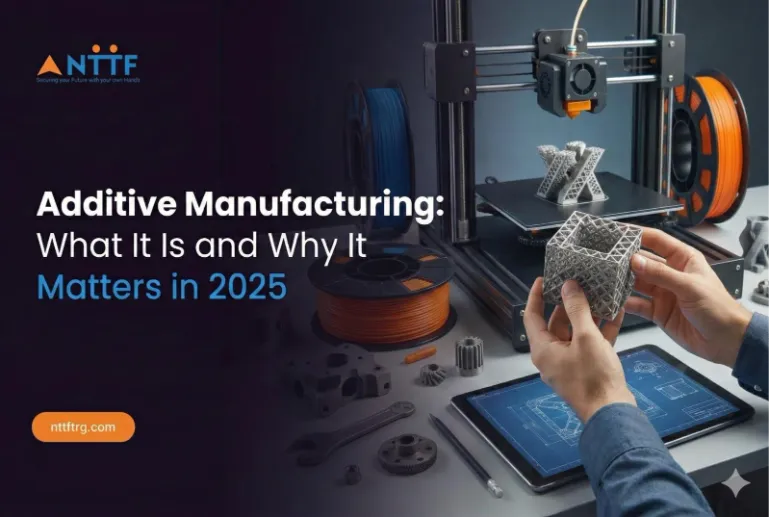
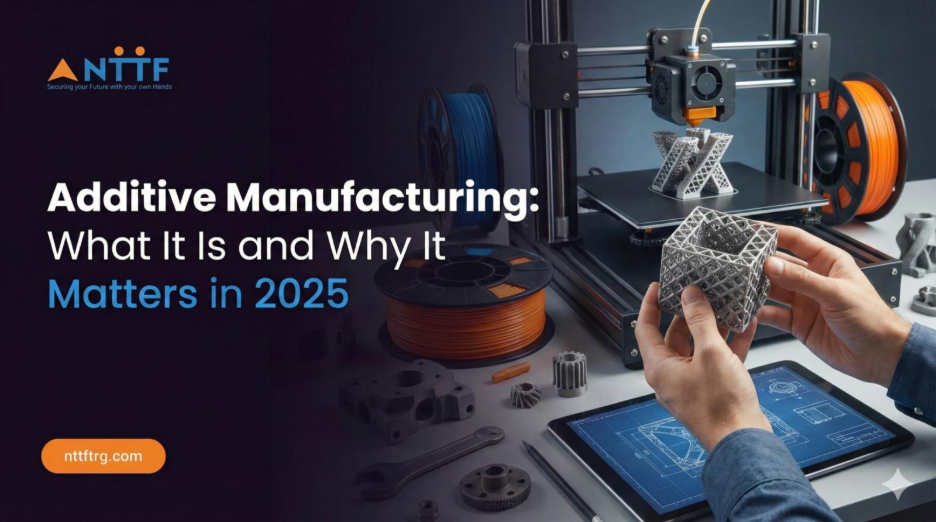
Additive manufacturing, often called 3D printing, is transforming all industries by altering how products are created, developed, and manufactured.
Usually in traditional subtractive production processes, the material is removed from a block to build a part. However, in additive manufacturing, the item is built layer-by-layer on top of a digital model. This process gives unmatched freedom of design and results in far less waste while providing rapid turnaround time from concept to production without delay.
Today, as we see ourselves in 2025, industries such as automotive, aerospace, healthcare, and consumer electronics are moving faster than ever, and they are taking up this technology for advanced manufacturing like printing lightweight aircraft components to create customized medical implants. In addition to this, additive manufacturing is changing the work boundaries/rules of what engineers and designers can do and achieve in manufacturing.
Why Additive Manufacturing Matters Today
Today, the important need and focus of manufacturers is flexibility, sustainability, and digital transformation. Earlier this was not possible, as there was no manpower to perform 3D printing. However, now with 3D printing programs at the core, this shift is possible, and they allow companies to:
- Rapidly prototype and test new designs for new innovations
- Manufacturing complex geometries that are impossible with traditional machines
- Unlike traditional processes, 3D printing helps reduce production costs through material efficiency
- It also enables customization for specific user or product needs
Note: Students who have completed 10th or 12th grade and professionals from related fields know that understanding additive manufacturing is no longer optional. It’s essential for staying relevant in the future of engineering and manufacturing.
About the Additive Manufacturing Course at NTTF
NTTF programs are designed to provide not only theoretical lessons but practical learning as well, and the 3D Printing Course is no exception. It’s built around hands-on learning, where students experience and learn how to design, print, and evaluate components using industrial-grade 3D printers and software. NTTF’s additive manufacturing program is designed for those who aspire to learn this emerging technology and want to gain practical experience during each of their semesters, relevant to industry needs.
Key Highlights of the Advance Certification Course
- The curriculum of this certificate course is designed to equip participants from mechanical, production, or mechatronics backgrounds with cutting-edge skills and knowledge to meet the evolving demands of the industry.
- Focus areas involve: CAD modeling, slicing software, 3D printer operation, material selection, and post-processing. This will help participants identify different industrial sectors, relevant additive manufacturing processes, and measurement techniques.
- Outcome: Upskill professionals with expertise in design for additive manufacturing and the latest developments in AM/3D/New Product Development, provide practical skills in the exciting realm of 3D printing, and provide in-depth knowledge of industry requirements in 3D printing/additive manufacturing.
The advanced certification course emphasizes real-world applications and upskills participants for roles in industries adopting digital and automated manufacturing practices.
Scope of Additive Manufacturing in 2025
There is high demand for skilled professionals in additive manufacturing. This role is rapidly expanding and generating employment like never before. How? It is because as industries integrate Industry 4.0 technologies, engineers trained in 3D printing courses play a key role in driving digital production systems.
Here’s how the scope looks ahead in upcoming years:
- Automotive: There is huge demand for lightweight part design, prototyping, and custom tools, and this will rule the market in the next few years.
- Aerospace: With continuous changes and demand for high-strength, lightweight metal components, the scope is huge in aerospace.
- Healthcare: There is never-ending demand in healthcare, and with custom implants, prosthetics, and surgical models, it will only see a rapid increase in manufacturing.
- Consumer Products: Every consumer needs new innovations and aesthetics, so for consumer products one can design lifestyle and industrial goods, which are again always in demand.
- Education & Research: Training next-gen innovators in sustainable manufacturing
By learning advanced additive technologies today, you position yourself for high-growth career opportunities and managerial roles across multiple industries.
What You Learn in NTTF’s 3D Printing Advance Certificate Course
The additive manufacturing classes at NTTF are carefully structured. It is designed to balance theory with hands-on experience (65% practical and 35% theory). Students learn how to take an idea from design to finished product using modern digital tools and 3D printers in NTTF labs.
Here are Some Core Learning Areas
- It includes everything from introduction to Additive Manufacturing principles, history, and applications to give a trainee basic clarification.
- Knowledge of Design for Additive Manufacturing (DfAM) which is a key component.
- It also includes CAD modeling & slicing software (SolidWorks, Fusion 360, Cura).
- Hands-on experience with 3D printing technologies (FDM, SLA, SLS, DMLS).
- Understanding material science for 3D printing like polymers, metals, and composites.
- Knowledge of post-processing techniques like finishing, polishing, and painting of products.
- Quality inspection & testing of printed components.
- Trainees would also be given project work to design, print, and present a live product prototype.
This approach basically ensures the participants move out confident in both conceptual design and technical execution, as these two skills are most demanded by employers today.
Course Duration and Fees
For all the details about the Advance Certification Course in 3D Printing at NTTF, you can visit the link below and inquire about your requirements. 3D Printing Certification Programs | Additive Manufacturing Course
NTTF provides industry-oriented training supported by experienced faculty and practical labs that mirror modern manufacturing environments.
Career Opportunities After the Course
Participants from NTTF’s 3D printing program are equipped for exciting careers and high-profile roles in the evolving world of digital manufacturing. Some of the typical job roles include:
| Job Profile | Job Description | Average Salary (per annum) |
| 3D Printing Technician | Operate and maintain additive manufacturing systems | ₹3–5 LPA |
| Design Engineer (Additive) | Develop and optimize 3D models for printing | ₹4–6 LPA |
| Product Development Engineer | Manage prototype and product iteration cycles | ₹5–8 LPA |
| Manufacturing Engineer | Integrate additive processes into existing production systems | ₹6–10 LPA |
| R&D Specialist | Research new materials, latest techniques, and real-world applications | ₹8–12 LPA |
Participants can also explore entrepreneurial paths, starting design studios or small-scale 3D printing ventures. NTTF strongly supports the young minds with new ideas.
Upcoming Trends in Additive Manufacturing
Since additive manufacturing is evolving at a breathtaking pace, there will be some amazing trends that we will witness. Here are some of the most promising trends shaping 2025 include:
- Hybrid Manufacturing: It basically includes combining traditional machine and additive techniques for precision manufacturing.
- Metal Additive Manufacturing: Here there is an expansion of high-strength alloys and composite printing.
- Sustainable 3D Printing: One of the most supported and environmentally friendly methods, where the use of bio-based and recyclable materials is done in manufacturing.
- AI-Driven Design: With AI being an important part of industries now, there would be generative design powered by artificial intelligence for optimized parts.
- 3D Printing in Space and Medicine: Creating tools, implants, and prototypes in extreme environments
Professionals who are trained through 3D printing courses are on the cutting edge of these developments, making them an indispensable and integral part of modern manufacturing ecosystems. So, if you want to be part of the next generation’s trends and want to help create something with an impact, enroll in the course today and level up your knowledge!
Why Choose NTTF?
Choosing NTTF for your 3D printing program means joining one of India’s most trusted and industry-connected training institutes, which has a legacy of over six decades in technical education. Moreover, NTTF bridges the gap between academic learning and industrial application by providing:
- 65% practical training through live industry projects
- Access to modern CAD/CAM and 3D printing laboratories
- Direct collaboration with leading manufacturing companies
- 100% Placement assistance through a vast network of over 1 lakh alumni in top industries
- Focused mentorship from experienced faculty and industry specialists for every subject
At NTTF students not only move out just with knowledge but also with practical skills and confidence to lead manufacturing transformation through additive manufacturing.
The future of manufacturing lies in digital design, smart production, and sustainable practices which are now all powered by additive manufacturing. So, whether you hold a diploma in mechanical engineering, are an early-career professional (3-4 years of experience), or are a designer wanting to upskill, NTTF’s 3D printing courses prepare you with the right knowledge to stay ahead of the curve.
Learning additive manufacturing from NTTF gives you more than just a certification. It’s your gateway to becoming part of a global movement that’s changing how the world designs, builds, and innovates.
Check out all the other details of the certification course at 3D Printing Certification Programs | Additive Manufacturing Course. You can also connect with the NTTF admissions team on the toll-free number for more information.