
What Skills are Required for a Mechanical Engineer?
March 25, 2026 2026-03-25 13:16What Skills are Required for a Mechanical Engineer?
Whenever someone talks about mechanical engineering, the first thing that comes to mind is either automobiles or machines. Many believe that’s all this field and take it as one of the easy disciplines of engineering. But reality is far more different: mechanical engineering is a vast and challenging discipline that connects with almost every industry today.
From the machines used in life-saving medical equipment to the appliances we use every day at home or work—mechanical engineering plays a key role everywhere. It is not just about nuts, bolts, and engines. It is about innovation, precision, and problem-solving.
So, if you want to become a career-ready professional, someone who not only focuses on theory but also wants to master practical skills, keep reading. Know what skills are required for a mechanical engineer. We have broken down the most important ones to help you understand better and make the right decision for your future.
1. Strong Basics in Mathematics and Physics
As mentioned above, mechanical engineering is not as easy as it sounds and looks. A mechanical engineer needs to have a strong understanding of both mathematics and physics. These are the building blocks of this field. You will often use concepts like calculus, algebra, thermodynamics, and mechanics in daily problem-solving. These basics help you understand how forces, energy, and materials behave, what more skills are needed, and whether you are designing a small component or an entire machine.
2. Problem-Solving Ability
Having a problem-solving approach is a must. You must know how to take on challenges, approach them with a clear mind, break them into smaller parts, and find logical solutions. Whether it is fixing a mechanical issue, designing a better machine, or reducing production costs—critical thinking and being evaluative always help.
3. Design and Creativity
Design is not limited to a certain type of art on canvas. It is also about function and performance. Being creative helps you think of new ideas, redesign systems, and improve existing machines in the best way possible. If you enjoy sketching, drawing, or imagining how things work, you already have one of the key skills needed in this field. But along with that, you also need to think out of the box.
At NTTF, we encourage this creative thinking and help you bring your ideas to life through practical training in design software and industry-related projects.
4. Hands-on Practical Knowledge
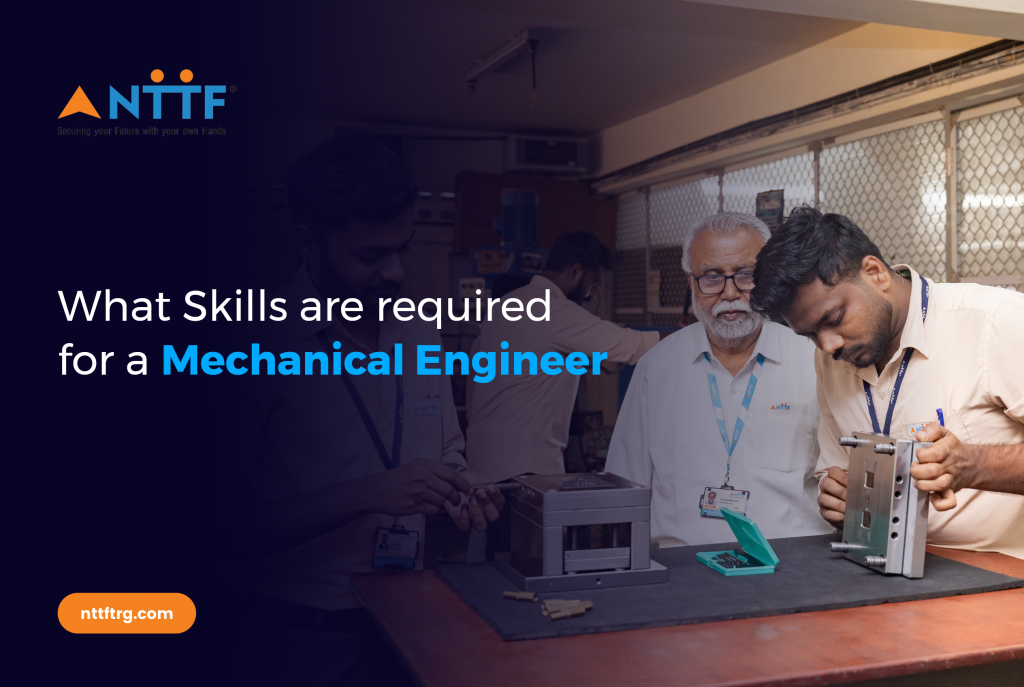
A lot of budding engineers and learners get stuck with plenty of theory but very little practice. The Mechanical Engineering Course is a practical subject. You must know how things actually work. That is why at NTTF, our focus is not just on books but on real-time, hands-on learning. Our labs, workshops, industry exposure, and simulation environments are designed to give you practical experience from day one.
If you are someone looking for mechanical engineering courses, make sure the course gives you a mix of both theory and practice—just like we do at NTTF.
5. Familiarity with Design Tools and Software
In the current phase of technical and practical learning, it is important to be skilled with different tools and other CAD (Computer-Aided Design) software. These tools not only help you to design and test but are also useful to develop mechanical systems digitally before they are manufactured.
Whether you are doing an mechanical engineering degree or attending a classroom course, software training is no longer optional. At NTTF, we make these tools a core part of your learning.
6. Teamwork and Communication Skills
As a mechanical engineer, you will work with other engineers, designers, technicians, and even clients. Being able to communicate clearly and work in a team is very important. It helps the project move faster and avoid confusion.
At NTTF, students regularly work on group projects, presentations, and real-world industry tasks that build both their soft and technical skills.
7. Time Management and Organization
Mechanical engineers often work with tight deadlines. Whether it is planning production, testing machines, or designing a prototype, every task needs to be done on time. Not only because competition is high, but also because giving the best matters.
At NTTF, we help students develop this skill through project-based learning and structured course planning.
8. Continuous Learning Mindset
We can see the visible changes in new materials, techniques, and tools that are being introduced every day. A good mechanical engineer is someone who keeps learning and growing over time.
NTTF supports this mindset. We make sure our students are industry-ready for today and for the future.
Hence, these are the basic yet powerful skills you need to grow as a mechanical engineer. Remember, mechanical engineering is not just about machines; it is about ideas, imagination, logic, and building what the world needs.
If you are curious to know how things work and want to design something better, this is the perfect field for you.
At NTTF, we offer industry-focused Mechanical Engineering courses that help you build real skills and gain practical exposure. Our programs combine theory and practice to make sure you are ready for real jobs from day one.
So, if you are ready to take the next step in your career, choose a path that builds your skills and shapes your future.
Explore our programs and learn more at https://nttftrg.com