As we are progressing in terms of research and new innovations, we are also witnessing a rapid advancement in technology across various industries. Such advances create new positions that call for people with the right skills, training, and vision. So, if you are someone who has or is considering completing a diploma in electronics, with a specialization in embedded systems, you are moving in the right direction for exciting job opportunities. With completion of this course you can step into role of your dreams that didn’t even exist a few years ago. This blog will cover:
- What are embedded systems & why is this field on rise?
- Key tech roles you can aim for after Diploma
- Skills required to land roles in this field
- How to choose right, embedded programming courses
- How choosing an embedded institute in Bangalore could be beneficial for you
What are Embedded Systems and Why is This Field on the Rise?
Today our life is very much dependent on the electronics that we use in our day-to-day life. Look around and you can find that everything is becoming smarter, connected and user friendly like home appliances, smartphones, wearables, medical devices, vehicles, industrial machines and even smart agriculture. But how do these devices work so smartly?
All this intelligence, Internet of Things (IoT), robotics, AI at the edge, automation and connectivity is made possible by embedded systems. In short, an embedded system is hardware (physical parts) and software (programs) that is designed to perform a particular function together seamlessly.
Since everything is now moving towards smarter innovations, and more efficient systems (battery-powered, low latency, secure) the demand for roles that bridge hardware and software is on peak. Companies need more skilled engineers to build these smart systems. But to get this skill set one needs to undergo proper training which can be done through a diploma in electronics. This diploma focuses on embedded systems gives you hands-on exposure to microcontrollers, sensors, firmware, and low-level programming – skills that are becoming indispensable.
Emerging Tech Roles You Can Target After Diploma
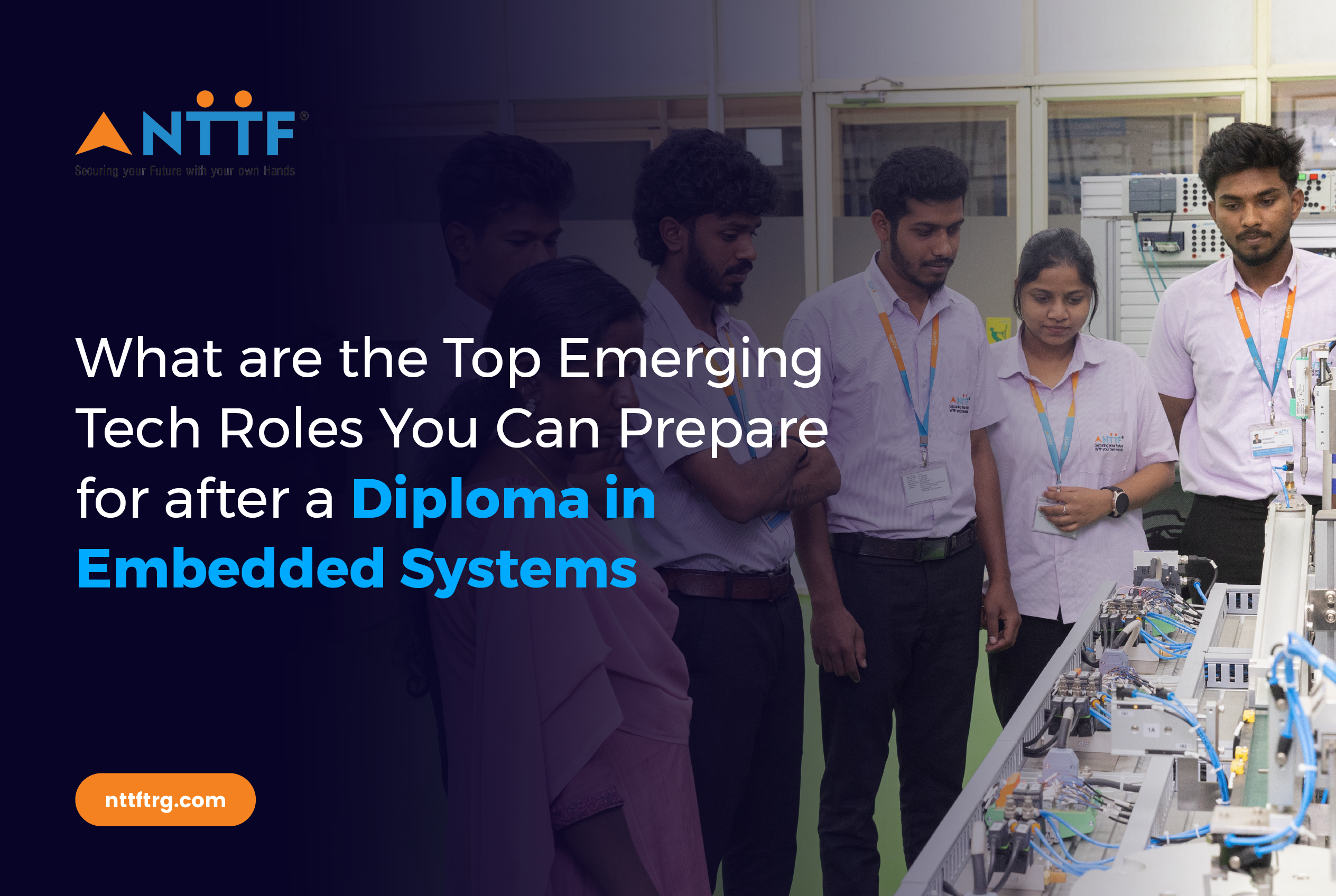
Here are some of the most promising roles you can prepare for after completing your diploma in embedded systems. These are not just “jobs that exist today” but roles likely to grow in demand over the next 3-5 years. Moreover, you can enter the workforce quickly as soon as you complete your diploma.
| Role | What You Will Do | Why It’s Emerging |
| Firmware Developer | Write the required low-level code in C or C++ that runs on microcontrollers, maintain bootloaders, manage memory, and optimize performance. | With increased usage of smart devices, firmware developers are important. Salary in India usually starts around ₹5-10 LPA for freshers. |
| IoT Embedded Engineer / Embedded Full-Stack IoT Analyst | Design hardware that senses data, connect it via wireless protocols (BLE, WiFi, LoRa etc.), process data locally, sometimes send to cloud. | As homes, cities, and industries adopt IoT, this role is booming. |
| Embedded Linux Developer | Work on Linux logic for embedded boards, write device drivers, manage kernel tweaks, optimize system resource usage. | Many telecom, router, and automotive applications need this. Salaries are often higher due to complexity. |
| Automotive Embedded Engineer | Majorly focus on control systems (ECUs), managing battery issues in EVs, sensor fusion, Working on safety modules etc. | The demand for electric vehicles, smart safety, autonomous features is continuously rising, which is why this is a fast-growing area. |
| FPGA / SoC Design Engineer | To design programmable logic devices and optimize circuits for speed & power you will have to use hardware description languages. | It is currently under one of the highest payrolls as it’s required in high-speed signal processing, telecom, 5G, aerospace. |
| Embedded AI / TinyML Engineer | Run lightweight machine learning models on embedded devices. For example, image recognition or sensor anomaly detection in very low power environments. | Popular as AI is being pushed to the edge. Companies want real-time performance without cloud dependencies. |
| Board Support Package (BSP) Engineer | Work on bootloaders, bring up embedded boards, configure device drivers, ensure OS interacts well with custom hardware. | Often required for custom hardware and industrial applications. Salaries tend to be middle-high due to specialization. |
| Embedded Systems Architect / Systems Integration Specialist | Oversee the full embedded system – hardware, firmware, networking, power management. Design how components communicate. Ensure performance, security, maintainability. | Senior role. As systems get complex, someone who understands the entire stack is very valuable. |
Note: The salary ranges, roles and demand also depend on location, company, and project. Always know your interest and research about it before you enter the workspace.
Skills You will Need to Land These Roles
It’s not enough to hold a diploma in embedded systems, you must have relevant, up-to-date skills. Here are what recruiters look for:
- Major requirement is proficiency in C, C++, or embedded Python
- Knowledge and understanding of microcontrollers, RTOS (Real-Time OS)
- Practical experience is always a plus with hardware protocols: I2C, SPI, UART, CAN, etc.
- Know-how of wireless communication can also be beneficial (BLE, WiFi, LoRa, ZigBee)
- Basics of Linux, especially Embedded Linux if targeting Linux roles
- Debugging tools, oscilloscopes, logic analyzers, hardware testing
- A good understanding of version control (Git), scripting for automation
- Edge AI / TinyML frameworks (TensorFlow Lite, OpenMV etc.)
- For any type of job role soft skills are a must which include problem solving, working across hardware/software, documentation
How to Select the Right Embedded Programming Courses
If you want to prepare well, your choice of training matters a lot. Here’s what to look for:
- Course structure that balances theory and lab practice. The best embedded programming courses provide real hardware labs and project work.
- Small class sizes so you actually get hands-on time.
- Use of modern tools & boards (ARM Cortex MCUs, ESP32, Raspberry Pi, development kits).
- Support for projects like IoT modules, sensor integration, maybe robotics or automation.
- Good faculty who has years of industry experience.
- Institute and course should connect you to companies via internships or placement assistance.
Why an Embedded Institute in Bangalore Could Be Beneficial
If you are considering where to study, NTTF Bangalore is a great location for embedded systems & electronics. Here’s why choosing NTTF embedded institute in Bangalore is smart choice:
- Many tech companies, hardware startups, IoT firms, and robotics companies are in Bangalore, Karnataka. NTTF has tie ups with more than 500 companies and that proximity can help you with exposure, internships, networking.
- NTTF has state of art infrastructure which includes everything from labs, availability of components, workshop culture, access to experts and industry visits.
- Ecosystem of embedded hardware, semiconductor design firms, design service companies.
- NTTF keeps organizing regular alumni & expert’s workshops, sessions in embedded / IoT / robotics to help you stay updated with everything that’s going on in the industry.
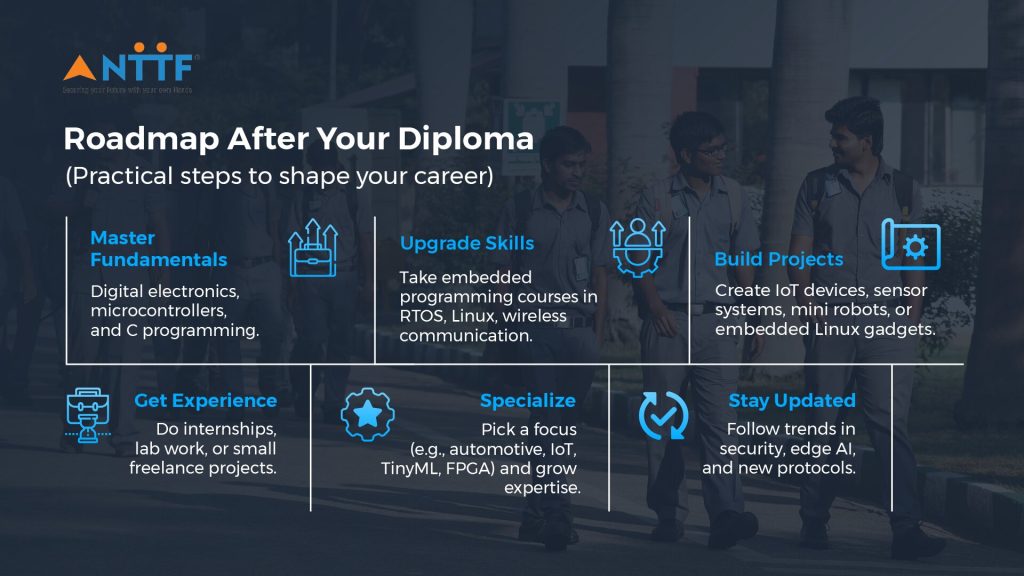
Hence, Emerging tech roles after a diploma in embedded systems are not just dreams—they are real and growing fast. If you hold a diploma in electronics, pair it with smart choices:
- Choose quality embedded programming courses
- Build strong hands-on skills
- Select an embedded institute in Bangalore or another tech hub
- Focus on more than one role you are passionate about (TinyML, IoT, firmware, etc.)
By doing this you will make not just employable decisions, but a smart move which will help you stay in demand.
If you are finishing (or planning) your diploma in embedded systems, this is the best time to plan ahead. Emerging roles like IoT Embedded Developer, Firmware Developer, Embedded Linux Engineer, and Embedded AI/ML Engineer offer growth, good salary, and future-proof work.
The trick is not just to study, but to build, prototype, solve, learn by doing. Choose your institute well, choose your courses smartly, and you’ll turn your diploma into a launchpad for a tech-rich career.