
What is a Diploma in Electrical and Electronics Systems?
January 12, 2026 2026-01-12 7:02What is a Diploma in Electrical and Electronics Systems?
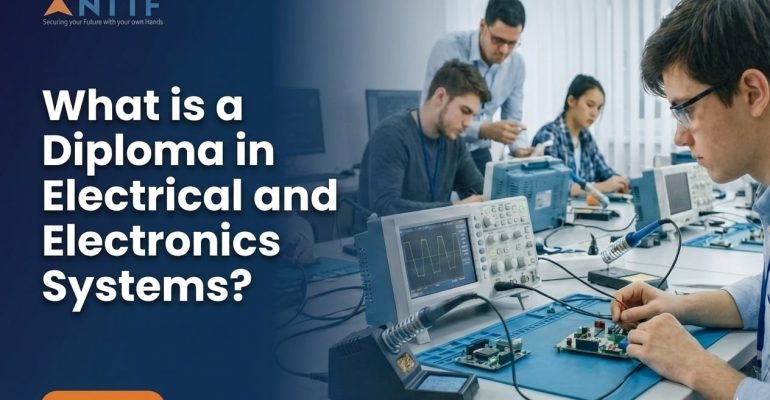
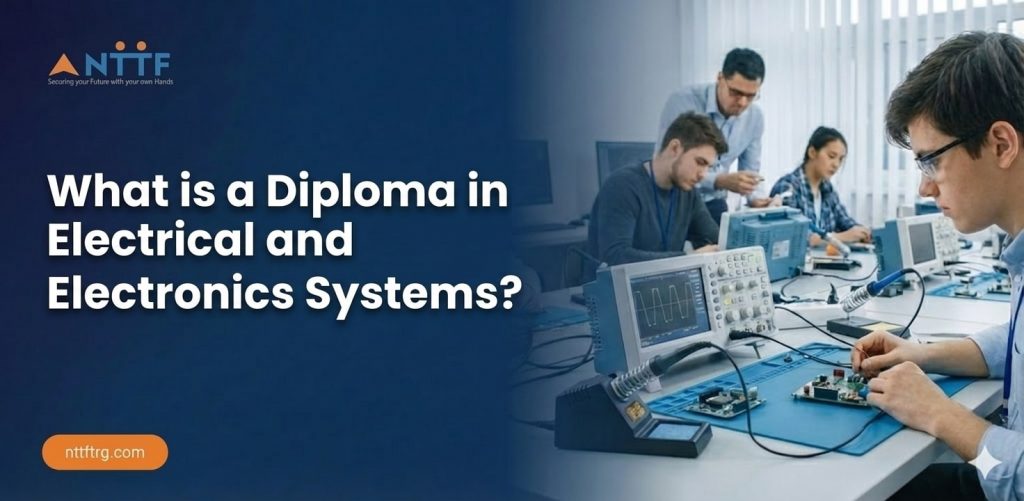
Have you ever wondered how the lights turn on with a simple switch or how your favorite gadgets work? Electrical and Electronics Systems, often called is a field that helps us understand and create the amazing technologies we use every day.
A diploma in Electrical and Electronics Systems is all about learning how electricity powers everything around us, from the bulbs in your home to the huge machines in factories. It also dives into electronics—things like computers, phones, and even the circuits that make robots move!
If you’re curious about how things work and want to be a part of building smarter, cooler devices for the future, a Diploma in Electrical Engineering could be the right path for you. Let’s explore what makes this field so exciting and how it can open doors to amazing career opportunities and equip you with the skills to shape a future powered by technology.
At NTTF (Nettur Technical Training Foundation), the Diploma in EE (CP23) offers a career-focused approach, blending in-depth theoretical knowledge with practical expertise. Whether your goal is to join a dynamic industry or innovate the next big thing, NTTF’s Diploma courses in Electrical and Electronics Systems is the key to unlocking your potential. Let’s explore how this diploma can electrify your career, prepare you for a tech-driven world, and position you as a leader in one of the most exciting engineering fields.
What is a Diploma in Electrical and Electronics Systems?
An Electrical Diploma is a specialized technical course designed to equip students with the fundamental principles and practical skills required to thrive in the field of electrical and Electronics Systems. This program delves into a wide range of subjects, from the intricacies of electrical circuits and electronic devices to the complexities of power systems, control systems, and renewable energy technologies.
Why Choose NTTF for Your Diploma in Electrical and Electronics Systems ?
NTTF (Nettur Technical Training Foundation) has a long-standing reputation as a leading provider of technical education. Our Diploma in Electrical and Electronics Systems Diploma program distinguishes itself through several key features:
- Industry-Driven Curriculum: Developed in close collaboration with industry experts, our curriculum ensures that students acquire the most relevant and up-to-date skills and knowledge sought after by employers. This focus on industry alignment ensures that diploma holders are well-prepared to meet the demands of the modern workplace.
- Hands-On Learning Experience: We believe that true understanding comes from practical application. Our program emphasizes hands-on learning through extensive laboratory sessions, workshops, and real-world projects. This approach allows students to bridge the gap between theory and practice, developing critical thinking and problem-solving skills in the process.
- Expert Faculty: Our faculty comprises experienced professionals and passionate educators who are deeply committed to student success. They provide guidance, mentorship, and support, fostering a conducive learning environment where students can thrive.
- State-of-the-Art Infrastructure: Students have access to modern, well-equipped laboratories featuring cutting-edge tools and technologies. This exposure to industry-standard equipment ensures that students gain practical experience in environments that mirror real-world workplaces.
- Comprehensive Career Support: Our dedicated placement cell provides comprehensive career guidance, interview preparation, and placement assistance. We have strong connections with leading companies in the field, facilitating opportunities for students to secure promising positions upon graduation.
Diploma in Electrical and Electronics Systems (CP 23) Curriculum Overview
Duration of program: 3 years( 6 semesters)
Entry Norms: Class 10th (Mathematics Mandatory)
Eligibility: PASS in class 10th as per state regulations and NTTF entrance exam.
Maximum Age Limit:24 Years
The Electrical Diploma at NTTF offers a comprehensive curriculum covering a broad spectrum of topics essential to a thorough understanding of electrical and Electronics Systems :
- Electrical Circuits and Machines Analysis: This foundational module delves into the fundamentals of circuit analysis, including DC and AC circuits, network theorems, and transient analysis. Students also gain a deep understanding of electrical machines, such as DC motors, generators, transformers, and AC motors, exploring their operating principles, characteristics, and applications.
- Electronics Devices and Circuits: This module explores the fascinating world of semiconductor devices, including diodes, transistors, and integrated circuits. Students learn about their characteristics, applications in analog and digital circuits, and their role as building blocks of modern electronics.
- Power Systems: This module provides a comprehensive understanding of power generation, transmission, and distribution systems. Students learn about different types of power plants, transmission lines, substations, and distribution networks. They also explore concepts related to power system stability, protection, and control.
- Control Systems: This module introduces students to the principles of control systems engineering. They learn about open-loop and closed-loop systems, feedback control, stability analysis, and various control strategies. This knowledge is essential for designing and analyzing systems that regulate processes in various industries.
- Instrumentation and Measurement: This module focuses on developing expertise in using different types of instruments to measure electrical and physical quantities. Students learn about measurement techniques, error analysis, and the selection and application of appropriate instruments for various measurement tasks.
- Renewable Energy Sources: With growing concerns about environmental sustainability, this module explores various renewable energy sources, including solar, wind, hydro, and biomass energy. Students learn about the principles, technologies, and applications of these renewable energy sources.
- Industrial Electronics and Automation: This module delves into the application of electronics in industrial settings. Students learn about programmable logic controllers (PLCs), industrial automation systems, process control, and the role of electronics in enhancing efficiency and productivity in various industries.
- Electrical CAD: This module introduces students to computer-aided design (CAD) software used for designing electrical circuits and systems. Students learn to create schematics, layouts, and simulations, gaining essential skills for modern electrical design and analysis.
- Communication Systems: This module provides a foundation in the principles of communication systems, including analog and digital communication, modulation techniques, and wireless communication. Students explore different communication technologies and their applications in various fields.
Beyond the Classroom: Enhancing Learning through Practical Experiences:
At NTTF, we believe that learning extends beyond the confines of the classroom. Our Diploma in Electrical and Electronics Systems program is enriched with various opportunities for students to gain practical experience and apply their knowledge in real-world settings:
- Laboratory Experiments: Students conduct experiments in well-equipped laboratories to reinforce theoretical concepts and develop practical skills. These experiments provide hands-on experience with various instruments, equipment, and measurement techniques.
- Workshops: We organize workshops conducted by industry experts to provide students with insights into specialized areas and emerging technologies. These workshops offer valuable practical knowledge and exposure to industry best practices.
- Industrial Visits: We arrange industrial visits to manufacturing plants, power stations, and other relevant facilities, allowing students to observe firsthand how Diploma in Electrical and Electronics Systems principles are applied in real-world settings. These visits provide valuable context and practical insights into various industries.
- Projects: Students undertake challenging projects that encourage teamwork, problem-solving, and innovation. These projects provide opportunities for students to apply their knowledge and skills to real-world scenarios, fostering creativity and critical thinking.
Career Pathways: A World of Opportunities Awaits:
A Diploma in Electrical Engineering from NTTF opens doors to a diverse range of career opportunities for diploma students across various sectors:
- Manufacturing: Graduates can find employment in electrical equipment manufacturing, electronics production, quality control, and maintenance roles. They can contribute to the design, development, and production of various electrical and electronic products.
- Power Generation and Distribution: The power sector offers opportunities in power plants, substations, electrical utilities, and renewable energy companies. Graduates can contribute to the generation, transmission, and distribution of electrical power, ensuring a reliable and sustainable energy supply.
- Automation and Robotics: With expertise in control systems and industrial electronics, graduates can pursue careers in automation and robotics. They can design, program, and maintain automated systems in various industries, contributing to increased efficiency and productivity.
- Construction and Infrastructure: Graduates can contribute to the electrical design and installation in buildings, transportation systems, and other infrastructure projects. They can work as electrical engineers, site supervisors, and project managers, ensuring the safe and efficient implementation of electrical systems.
- Telecommunications: The telecommunications industry offers opportunities in network infrastructure, wireless communication, fiber optics, and telecommunications equipment manufacturing. Graduates can contribute to the development and maintenance of communication networks that connect people and businesses globally.
- Maintenance and Repair: Graduates can provide technical support and maintenance services for electrical and electronic equipment in various industries. Their skills are essential for ensuring the smooth operation of critical equipment and minimizing downtime.
- Entrepreneurship: With the knowledge and skills gained from the Diploma in Electrical and Electronics Systems program, graduates can venture into entrepreneurship, starting and managing businesses in electrical contracting, electronics repair, or renewable energy solutions.
Conclusion:
A Diploma in EE from NTTF provides a strong foundation for a successful and fulfilling career in the ever-evolving field of technology. With its emphasis on industry-relevant skills, practical training, and comprehensive career support, this program empowers students to become highly skilled professionals who can contribute to advancements in electrical and Electronics Systems. By choosing a Diploma in Electrical and Electronics Systems (CP 23) from NTTF, students embark on a path filled with opportunities to make a meaningful impact in a world increasingly reliant on technology.