
To shape one’s career prospects well, choosing the correct educational pathway after 10th or 12th standard is a crucial decision. Whether to go for a degree, a certificate course, or a diploma is a common problem among all students today. Each path offers different benefits and challenges and manages diverse timelines and career goals.
Students and experts with a keen interest in industry-ready and technical skills find the differences between degrees, diplomas, and certificates through this blog. Also, it will help you to understand which path works the best and how NTTF diploma courses and PG programs in Bangalore could be a good fit for your future.
Understanding: Diploma, Degree, and Certificate Programs
What is a Diploma Course?
A diploma course is a vocational, skill-based course that is typically completed in less time than a degree and is concerned with both industry-focused knowledge and skills to work in an industry. At NTTF, diploma programs are specially organized with 65% practical training and 35% theoretical knowledge, which provides students with practical experience and skills. These courses are usually 1-3 years and can accept students who have completed 10th or 12th standard or ITI level.
What is a Degree Program?
Degree programs are typically three or four-year academic programs with a wide curriculum. Such programs are based majorly on theoretical and few sessions of practical aspects to prepare students for different professional or academic tasks, including study at higher degrees. NTTF does not provide traditional degree programs, though it focuses on post-diploma technical education and diplomas.
What are Certificate Courses?
Certificates or certification courses are short term courses that take a few weeks to several months and are aimed at giving a rapid upgrade of skills or niche expertise in a particular technology. NTTF provides certificate training to support technical education and develop particular skills in a short period of time.
The Common Challenges Students Face When Choosing Between Diploma, Degree, and a Certification
- Time & Duration of Course
- Which one is affordable diploma/certification options
- Do diplomas offer industry exposure
- Which path can prepare for technical job-readiness
- Will I get training in advance labs
- Are there multi-entry exit options
As the job market continues to change and requires pragmatic skills, most students consider that traditional degree programs are long and expensive and do not match the requirements of the industry. Conversely, low-level certificate programs can offer rapid training but not in-depth training, and do not have a broad acceptance. Thus, students are in search of a balanced and efficient educational course that provides them with solid theoretical bases as well as with sufficient practical experience.
The NTTF diploma programs overcome these issues by integrating theory with practical applications to provide a holistic but specialized learning experience. Also, it offers state-of-the-art industry-relevant courses through its Diploma programs in Bangalore to trainees who wish to graduate with advanced specialization.
Why Should you prefer NTTF Diploma Courses? The Best Path After 10th or 12th?
NTTF diploma programs give more emphasis to practical experience, ensuring 65% of the course is practical training. The strategy helps students to work with actual machines, projects, and software so that they can be ready to face challenges in the industry on the first day.
Course Variety and Industry Focus
NTTF offers numerous diploma courses with its focus on current and emerging industry areas:
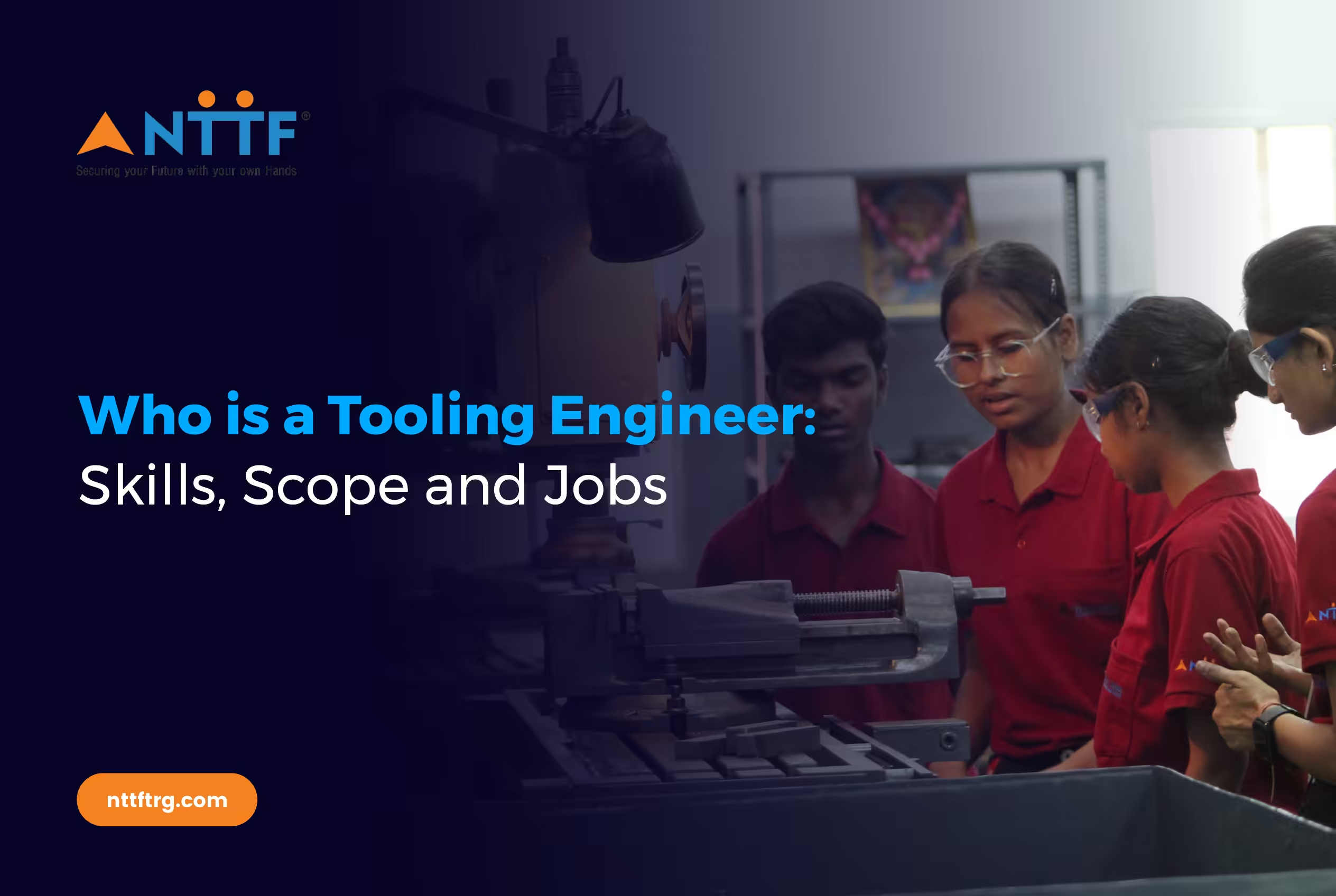
- Diploma in Tool Engineering & Digital Manufacturing (CP01)
- Diploma in Computer Technology and IT Infrastructure (CP08)
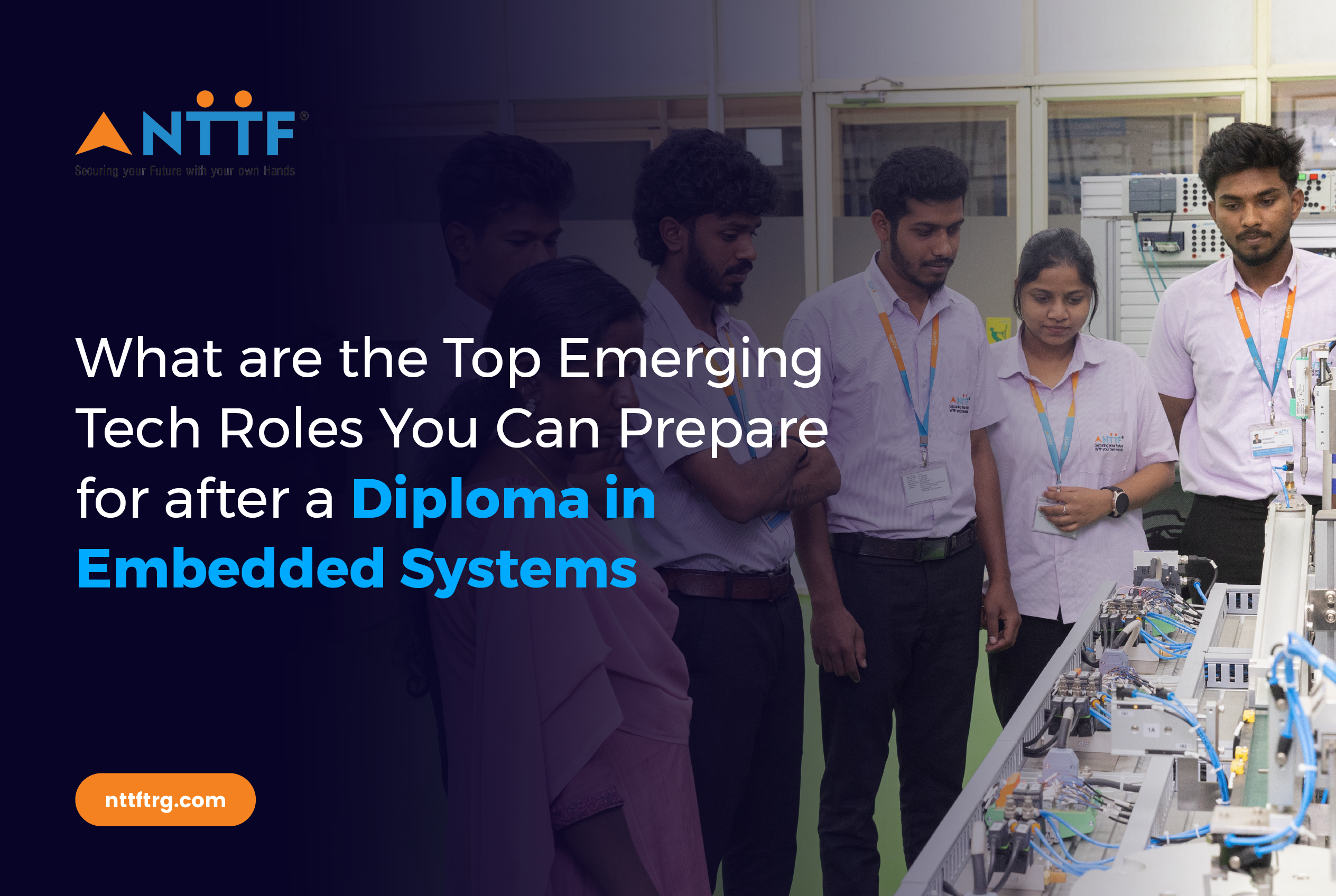
- Diploma in Electronics and Embedded Systems (CP04)
- Diploma in Information Technology and Data Science (CP09)
- Diploma in Electrical and Electronics Systems (CP23)
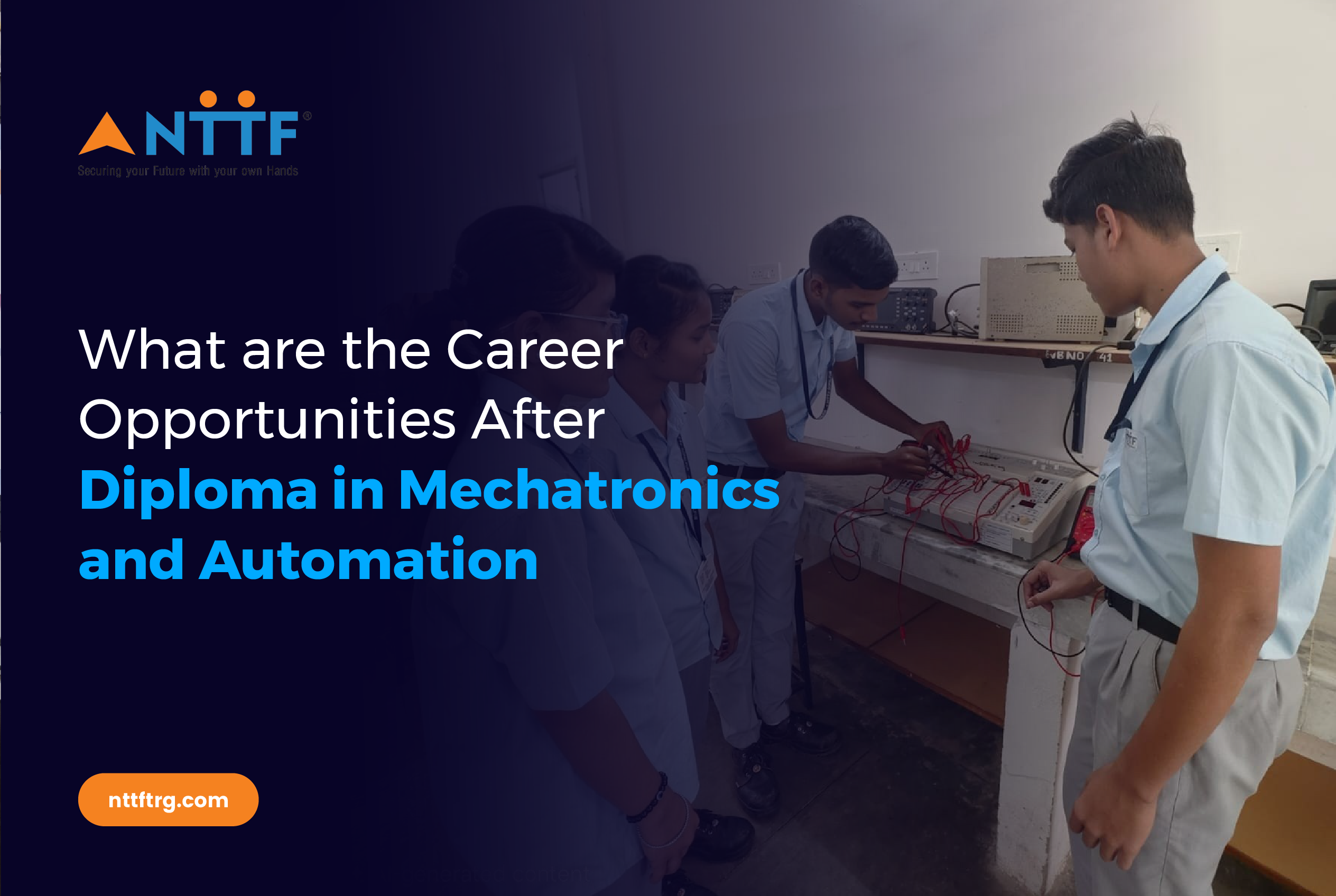
- Diploma in Mechatronics Engineering and Smart Factory (CP15)
These courses are globally accredited, certifying recognition and advancing employability worldwide.
Flexible Entry and Exit
NTTF has multi-entry-exit options where students are able to join, pause, or graduate from programs as it suits them. Lateral entry into the second year is offered for students with 12th or ITI eligibility.
Learn, Earn, and Grow with NTTF
The Learn and Earn approach is a blend of practical training and theory lessons, as it allows the trainee to receive a best training in the labs and then they can start with stipend internships during vacations. This exposure does not just improve the skills but also increases the confidence and employability chances for students.
International Accreditation and Placement Assistance
NTTF is a globally established awarding body and accredited by NOCN UK as well as NCVET and the MSDE Government of India. The institute also best collaboration systems with more than 450 companies, which ties the students to high-paying employment opportunities, both locally and internationally.
When to Choose Certificate Courses at NTTF?
NTTF certificate courses are offered to individuals who require a short course to upgrade their skills or specialization. These are short-term, high-focus programs that equip students or working professionals with industry-relevant skills that help them to upskill at a high rate.
Exploring Post Diploma Programs in Bangalore at NTTF: For Graduates and Professionals
In the case of engineering students who already hold Diploma, NTTF also provides post diploma courses in Bangalore, which aim to enhance specialized technical and managerial competence demanded in the manufacturing and design sector.
List of Popular Post Diploma Programs:
- Post Diploma in Tool Design (CP05)
- Post Diploma in Power Electronics (CP10)
- Post Diploma in Embedded Systems and IoT (CP18)
- Post Diploma in Industrial Automation (CP19)
These programs span for a year and completely focus on practical skills, which allow trainees to take up better positions in different roles like R&D, design teams, quality control, and management in the manufacturing sector.
Why Should you prefer NTTF Post Diploma Programs in Bangalore?
As an industrial and technological centre in Bangalore NTTF provides post diploma programs with advanced equipment and technology, skilled professors and close sector affiliations. These post diplomas are ideal to those who want to upgrade their skills in a way that resonates with the employer requirements.
Diploma vs Degree vs Certification vs PG Programs: A Comparative View
| Feature | NTTF Diploma Courses | Certificate Courses (NTTF) | Degree Programs | Post Diploma Programs (NTTF) |
| Eligibility | 10th / 12th / ITI | Varies, flexible | 12th + entrance exams | Engineering Graduates (B.E/B.Tech) |
| Duration | 3 years | Few months | 3 to 4 years | 1 year |
| Focus | 65% Practical + 35% Theory | Skill-specific, short-term | Theory + Practical | Advanced technical + managerial skills |
| Industry Recognition | NOCN UK and NCVET Accreditation | Varies, recognized by industries | National & International | Recognized PG diploma certification |
| Career Outcomes | Job-ready in technical roles | Skill upgrade, rapid employment | Academic/technical careers | Specialized roles in design, quality, R&D |
| Cost and Time Investment | Affordable, short to medium | Low cost, short duration | Costly,time-consuming | Moderate cost and duration |
| Practical Training | High emphasis | Moderate | Moderate | High emphasis |
| Placement Assistance | Excellent | Good | Depends on institution | Excellent placement support |
How to Choose the most appropriate course to your future?
- Take NTTF diploma courses in case you are looking to begin your career immediately after the 10th or 12th grade with more practical experience and international recognition.
- Choose certificate courses when you need to have fast-track upskilling or diversification of skills.
- Take into account degree courses in case of in-depth academic knowledge and the opportunity to study much more.
- Prefer Post diploma programs if you want to upskill more after diploma and in case you hold a degree already you can also consider PG program in Bangalore at NTTF school of post graduate studies. It also to specialise with industry-based skills within a brief period.
The education model of NTTF is based on the modern demands of the industry, which is a combination of practical skills and credible certifications, as well as international recognition. Diploma courses provide an ideal combination of practical education and theory beyond the 10th or 12th standard. However, in Bangalore, the graduate-level engineering students at NTTF can acquire state-of-the-art knowledge and leadership competencies.
When the idea is new to the workforce and needs real-world skills or to upgrade technical skills to prestigious positions, a combination of diploma and postgraduate programs at NTTF offers affordable and flexible career advancement paths that are industry-relevant and aligned.
Explore NTTF’s offerings today and get yourself in charge of your future confidently, with practical skills and a blueprint that is developed to open the world to you.